IELTS Writing Task 1 map: how to describe changes, with a model answer
Compare a place before and after with direction and change-of-state language. Overview, grouping, band 5–7 samples and a full model report.
Last reviewed: · By the Engleasy team
Read the visual first
Map questions usually show one place before and after redevelopment. You describe what changed, what stayed the same and where each change took place.
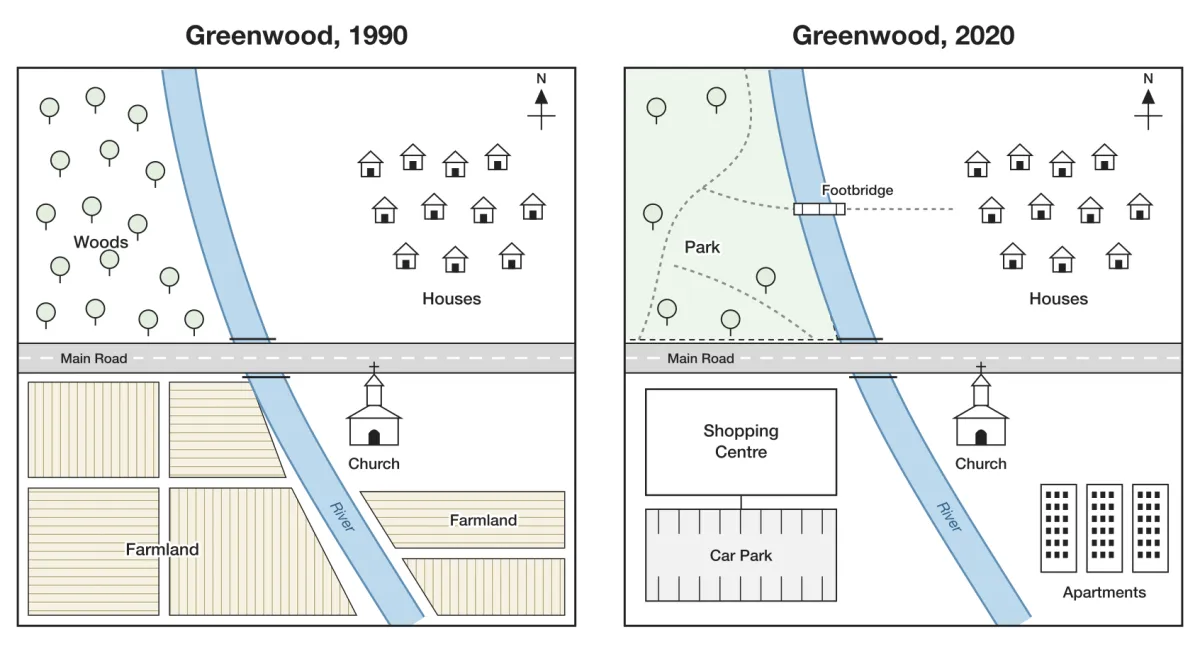
The task
The two maps below show the town of Greenwood in 1990 and after redevelopment in 2020. Summarise the information by selecting and reporting the main features, and make comparisons where relevant.
At least 150 words · about 20 minutes
Four paragraphs
- Introduction: One sentence that says what the visual shows, in your own words.
- Overview: Two or three sentences on the main features, with no figures.
- Details 1: The first group of features, with figures to support them.
- Details 2: The second group, compared with the first where it helps.
Say what it shows, in your own words
Check yourself
Which introduction would score better?
- A.The two maps show the town of Greenwood in 1990 and after redevelopment in 2020.
- B.The maps illustrate how Greenwood changed from 1990 to 2020 following a redevelopment programme.
Show the answerHide the answer
Answer: B
The weaker one copies the task. Copied wording shows the examiner nothing about your own English, so paraphrase it: same facts, new words.
Introduction
The maps illustrate how Greenwood changed from 1990 to 2020 following a redevelopment programme.
Both dates in one sentence, and following a redevelopment programme restates after redevelopment in new words.
Ways to paraphrase the task
- Swap the verb: shows → compares, illustrates, gives information about.
- Rephrase the data: the number of hours → how many hours; the proportion of → what share of.
- Restate the time: between 1990 and 2020 → over a thirty-year period.
The big picture, without numbers
Check yourself
Look at the visual again, then choose.
Which sentence works best as the overview?
- A.Overall, a large shopping centre with its own car park was built on the old farmland in the south-west of the town.
- B.Overall, Greenwood is a much better place to live in 2020 than it was in 1990, with more shops, homes and green space.
- C.Overall, the farmland was replaced by shops and flats and the woods became a park, while the houses and church stayed.
Show the answerHide the answer
Answer: C
The overview names the main changes and what stayed. The shopping centre alone is one detail, and a better place to live is an opinion the maps cannot support.
Model overview
Overall, Greenwood became far more built-up, as the farmland in the south gave way to shops and housing and the woods were turned into a park. The river, the main road, the houses and the church, however, remained as they were.
The two biggest changes come first, then what stayed the same. gave way to is a useful verb for one thing replacing another.
Group the details and compare
Check yourself
Check each sentence against the visual.
Which sentence matches the maps?
- A.The houses in the north-east were demolished.
- B.The shopping centre was built on the east bank of the river.
- C.The church is in the same place on both maps, on the east bank.
Show the answerHide the answer
Answer: C
The church stands south of the main road on the east bank in both years. The houses are still there in 2020, and the shopping centre is on the west bank, in the south-west.
Details 1: The south of the town
The most dramatic change took place south of the main road, where the farmland that covered this part of the town in 1990 was completely cleared. In its place, a large shopping centre with a car park was built in the south-west, on the west bank of the river, while three apartment blocks went up on the east bank, to the south-east of the church. The church itself was unchanged, still standing just south of the main road on the east side of the river.
took place and south of the main road say what and where, and the relative clause links back to the first map. In its place signals a replacement, and each new building gets an exact location: in the south-west, on the west bank, on the east bank, to the south-east of the church. Saying what did not change is part of a complete answer, and the location matches the first map.
Details 2: The north of the town
In the north-west, the woods on the west bank were converted into a public park, with footpaths running through it. A new footbridge was also built across the river, linking the park to the houses in the north-east, which were still standing in 2020. The main road continued to cross the town from west to east, passing over the river at the same point as before.
were converted into is a passive change verb, and in the north-west places it. One sentence gives a new feature, says what it connects, and adds with which were still standing that the houses did not change. continued to and at the same point as before describe a feature that did not change.
Words for this kind of visual
Useful phrases
- was replaced by / converted into
- in the north / south / west / east
- on the east bank
- remained unchanged
- in its place
Tips
- Use directions: in the north-west, to the south of the main road, on the east bank.
- Use change verbs in the passive: was replaced by, was converted into, was demolished, was built.
- Mention what stayed the same. It shows you covered the whole map.
Common mistakes
- No overview, or an overview buried in the last line.
- Listing every figure instead of choosing the important ones.
- Giving an opinion or a reason that the visual does not show.
The same visual at bands 5, 6 and 7
Most learners write somewhere between band 5 and band 7. Here is the start of a report on this visual (the overview and the first details paragraph) at each level, with what changes on each criterion.
Check yourself
Two overviews of the same visual.
Which of these overviews would score higher?
- A.Overall, Greenwood became much more built-up: the farmland in the south was replaced by shops and housing, and the woods in the north-west became a park. The river, the main road, the houses and the church, however, were unaffected.
- B.Overall, the town became more developed, with new buildings such as shops and flats replacing the farmland in the south, while some features like the houses, the church and the main road did not change.
Show the answerHide the answer
Answer: A
Both are accurate, but the weaker one leaves out the woods becoming a park, one of the two main changes. The stronger one names both main changes and what stayed the same.
Overview and first details paragraph
Question
The two maps below show the town of Greenwood in 1990 and after redevelopment in 2020. Summarise the information by selecting and reporting the main features, and make comparisons where relevant.
Band Around 5
The maps show Greenwood in 1990 and 2020. There are many changes. In 1990 there was woods, farmland, houses and a church. In 2020 the woods is a park and there is a new bridge. The farmland is not there, now there is a shopping centre and a car park. Also there is three apartments next to the shopping centre on the west of the river. The houses and the church is same.
- Task Achievement: the overview names no main change (many changes). The details list what is on each map without saying where most things are, and one location is wrong: the three apartment blocks stand on the east bank, south-east of the church. They are not beside the shopping centre. Band 6 gives an overview of the main changes and places each one.
- Coherence and Cohesion: the sentences jump between the north and the south of the town, and Also and a comma (is not there, now) are the only links. Band 6 takes one area at a time.
- Lexical Resource: vague words (a new bridge for the footbridge, three apartments for three apartment blocks, is same), and no change verbs. Band 6 uses verbs such as was replaced, was built and was changed into.
- Grammatical Range and Accuracy: simple sentences with frequent agreement errors (there was woods, the woods is, there is three, the church is same), and no passive. Band 6 uses the past passive for changes.
Band Around 6
Overall, the town became more developed, with new buildings such as shops and flats replacing the farmland in the south, while some features like the houses, the church and the main road did not change. In the south of the town, the farmland was removed and a shopping centre with a car park was built on the west side of the river. On the other side of the river, three apartment blocks were built near the church. In the north, the woods was changed to a park and a footbridge was built to connect it with the houses.
- Task Achievement: a relevant overview, accurate as far as it goes, but it leaves out one of the two main changes: the woods becoming a park. The details are accurate but not always precise (near the church, where the blocks are to its south-east). Band 7 names all the main changes in the overview and gives exact locations.
- Coherence and Cohesion: clear progression, with In the south and In the north organising the changes, but a paragraph meant for the south ends in the north. Band 7 keeps each paragraph to one area.
- Lexical Resource: adequate (more developed, connect it with), but general words such as removed and changed to where cleared and converted into are more precise.
- Grammatical Range and Accuracy: the past passive is used well (was built, were built), with one agreement error (the woods was).
Band Around 7
Overall, Greenwood became much more built-up: the farmland in the south was replaced by shops and housing, and the woods in the north-west became a park. The river, the main road, the houses and the church, however, were unaffected. The most significant changes took place south of the main road, where the farmland on both banks of the river was cleared. On the west bank, it made way for a large shopping centre with a car park to its south, while on the east bank three apartment blocks were built to the south-east of the church, which itself was unchanged.
- Task Achievement: a clear overview of both main changes and of what stayed, and every location matches the maps. To reach band 8, the key features would be extended more fully, for example the footbridge linking the new park to the houses.
- Coherence and Cohesion: the paragraph keeps to the south, moving from the west bank to the east, with reference (it, its south, which itself) holding it together.
- Lexical Resource: precise change language (was cleared, made way for, were unaffected) and exact directions (to the south-east of).
- Grammatical Range and Accuracy: varied complex sentences (relative clauses with where and which, a contrast with while), all accurate. Band 8 keeps this control over the whole report.
The model report, paragraph by paragraph
Here are the same sentences put together as one report. Read it with the visual open and check every figure.
Model report
Question
The two maps below show the town of Greenwood in 1990 and after redevelopment in 2020. Summarise the information by selecting and reporting the main features, and make comparisons where relevant.
Written at about band 8
Introduction
The maps illustrate how Greenwood changed from 1990 to 2020 following a redevelopment programme.
Both dates in one sentence, and following a redevelopment programme restates after redevelopment in new words.
Overview
Overall, Greenwood became far more built-up, as the farmland in the south gave way to shops and housing and the woods were turned into a park. The river, the main road, the houses and the church, however, remained as they were.
The two biggest changes come first, then what stayed the same. gave way to is a useful verb for one thing replacing another.
Details: the south of the town
The most dramatic change took place south of the main road, where the farmland that covered this part of the town in 1990 was completely cleared. In its place, a large shopping centre with a car park was built in the south-west, on the west bank of the river, while three apartment blocks went up on the east bank, to the south-east of the church. The church itself was unchanged, still standing just south of the main road on the east side of the river.
took place and south of the main road say what and where, and the relative clause links back to the first map. In its place signals a replacement, and each new building gets an exact location: in the south-west, on the west bank, on the east bank, to the south-east of the church. Saying what did not change is part of a complete answer, and the location matches the first map.
Details: the north of the town
In the north-west, the woods on the west bank were converted into a public park, with footpaths running through it. A new footbridge was also built across the river, linking the park to the houses in the north-east, which were still standing in 2020. The main road continued to cross the town from west to east, passing over the river at the same point as before.
were converted into is a passive change verb, and in the north-west places it. One sentence gives a new feature, says what it connects, and adds with which were still standing that the houses did not change. continued to and at the same point as before describe a feature that did not change.
Try it on your own answer
Write a Task 1 or Task 2 answer, or record a Speaking answer, and get an estimated band for each criterion with every mistake explained. Free plan forever, no card needed.