IELTS Writing Task 1 process diagram: describe the stages, with a model answer
Describe each stage in order, use the passive where it fits, and write an overview of the whole process. Band 5–7 samples and a full model report.
Last reviewed: · By the Engleasy team
Read the visual first
Process diagrams show the stages of a natural or manufacturing process. You describe each stage in order, usually in the passive, and say only what the diagram shows.
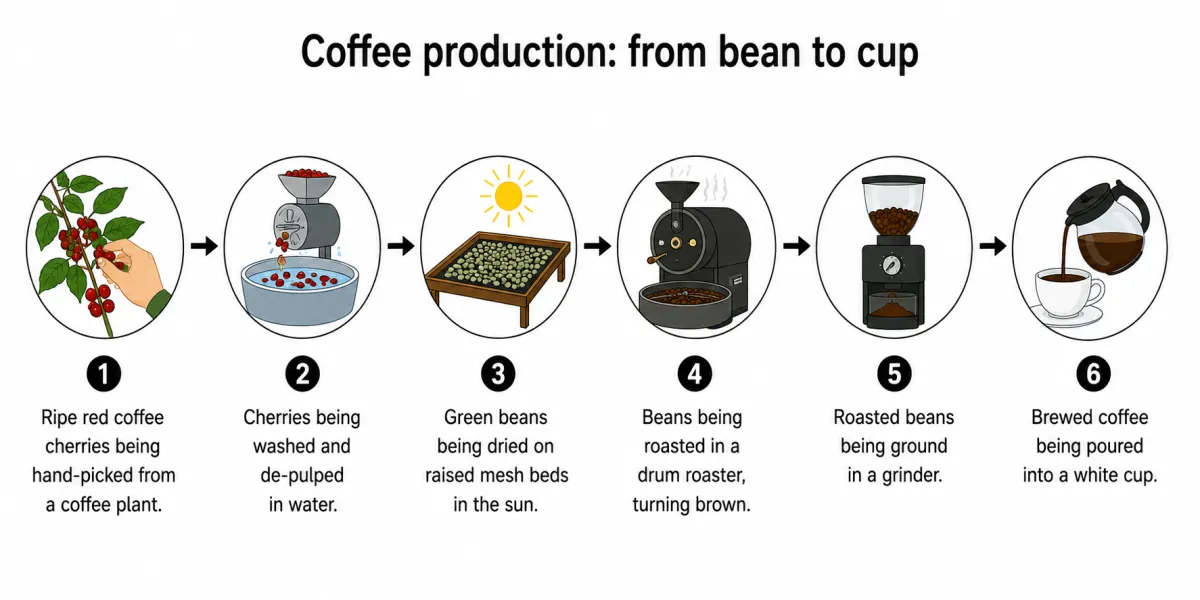
The task
The diagram below illustrates the process by which coffee is produced, from bean to cup. Summarise the information by selecting and reporting the main features.
At least 150 words · about 20 minutes
Four paragraphs
- Introduction: One sentence that says what the visual shows, in your own words.
- Overview: Two or three sentences on the main features, with no figures.
- Details 1: The first group of features, with figures to support them.
- Details 2: The second group, compared with the first where it helps.
Say what it shows, in your own words
Check yourself
Which introduction would score better?
- A.The diagram illustrates the process by which coffee is produced, from bean to cup.
- B.The diagram outlines the six stages of making coffee, from picking the cherries to brewing the drink.
Show the answerHide the answer
Answer: B
The weaker one copies the task. Copied wording shows the examiner nothing about your own English, so paraphrase it: same facts, new words.
Introduction
The diagram outlines the six stages of making coffee, from picking the cherries to brewing the drink.
outlines replaces illustrates, and naming the number of stages, the start and the end gives the reader the whole process in one sentence.
Ways to paraphrase the task
- Swap the verb: shows → compares, illustrates, gives information about.
- Rephrase the data: the number of hours → how many hours; the proportion of → what share of.
- Restate the time: between 1990 and 2020 → over a thirty-year period.
The big picture, without numbers
Check yourself
Look at the visual again, then choose.
Which sentence works best as the overview?
- A.Overall, the cherries are first picked by hand and washed in water, then dried in the sun, roasted in a drum, ground and finally brewed.
- B.Overall, coffee takes several weeks to produce, mostly because the beans need a long time to dry in the sun.
- C.Overall, there are six stages, from picking the fruit to brewing the drink, in two halves: preparing the beans, then making the coffee.
Show the answerHide the answer
Answer: C
The overview describes the process as a whole. The list of every step is detail, and the one about weeks adds times the diagram does not give.
Model overview
Overall, coffee production is a six-stage process that moves from harvesting and preparing the fruit to roasting, grinding and finally brewing. The first half turns the fruit into dried beans, and the second turns those beans into a drink.
It gives the shape of the whole process (how many stages, where it starts and ends, the two halves) without walking through each step.
Group the details and compare
Check yourself
Check each sentence against the visual.
Which sentence matches the diagram?
- A.The beans are dried before they are roasted.
- B.The beans are ground before they are roasted.
- C.The cherries are dried in the sun before they are picked.
Show the answerHide the answer
Answer: A
Drying is stage 3 and roasting stage 4. Grinding comes after roasting, and picking is the very first stage.
Details 1: From plant to dried bean
In the first stage, ripe red cherries are hand-picked directly from the coffee plant. These cherries are then washed and de-pulped in water to remove the outer fruit, leaving the green beans inside. Next, the beans are spread out on raised beds and left to dry in the sun.
The present simple passive (are hand-picked) keeps the focus on what happens, not on who does it. then moves the sequence on, and leaving the green beans sets up the next stage. Next varies the sequencers. The sentence adds nothing the diagram does not show, such as how long drying takes.
Details 2: From roasting to brewing
Once dried, the beans are roasted in a drum roaster, during which they darken to a rich brown colour. The roasted beans are then ground into a fine powder, ready for the final step. Finally, coffee is brewed from the ground beans, poured into a cup and served.
Once dried links this stage to the last one, and during which adds what happens while they roast. ready for the final step points forward without repeating the word next. Finally closes the sequence, and three passive verbs in a row (brewed, poured, served) cover the last stage.
Words for this kind of visual
Useful phrases
- are picked / washed / dried
- in the first stage
- then / next / after that
- once + past participle
- finally, the … is …
Tips
- Use the present simple passive (is picked, are washed). Most process descriptions are written this way.
- Hold the order together with sequencers: first, then, next, after that, once, finally.
- Name what goes in at the start and what comes out at the end. It shows you understood the diagram as a whole.
Common mistakes
- No overview, or an overview buried in the last line.
- Listing every figure instead of choosing the important ones.
- Giving an opinion or a reason that the visual does not show.
The same visual at bands 5, 6 and 7
Most learners write somewhere between band 5 and band 7. Here is the start of a report on this visual (the overview and the first details paragraph) at each level, with what changes on each criterion.
Check yourself
Two overviews of the same visual.
Which of these overviews would score higher?
- A.Overall, there are six stages in the process, starting with picking the coffee cherries and ending with a cup of coffee.
- B.The diagram shows how to make coffee. There are many steps. Every step is important to make a good coffee.
Show the answerHide the answer
Answer: A
The stronger overview says how many stages there are and where the process starts and ends.
Overview and first details paragraph
Question
The diagram below illustrates the process by which coffee is produced, from bean to cup. Summarise the information by selecting and reporting the main features.
Band Around 5
The diagram shows how to make coffee. There are many steps. Every step is important to make a good coffee. First, people pick the coffee from the tree by hand. Then they wash the cherries in water. Then the beans is dry in the sun on the table. Then they roast the beans in a machine for about 20 minutes and the beans become black.
- Task Achievement: no real overview: it does not say how many stages there are or where the process starts and ends. The details add a time (about 20 minutes) that the diagram never gives, and one detail is wrong: the beans turn brown, not black. Band 6 gives a short overview of the stages and keeps to what is shown.
- Coherence and Cohesion: the order is right, but Then opens three sentences in a row. Band 6 varies the sequencers (After that, Next, In the first stage).
- Lexical Resource: general words replace the diagram's own (the coffee for the cherries, the table for the raised beds, a machine for the drum roaster), and de-pulping is left out. Band 6 uses the process words correctly.
- Grammatical Range and Accuracy: active sentences with people and they instead of the passive, and an agreement error (the beans is dry). Band 6 uses the present simple passive, mostly accurately.
Band Around 6
Overall, there are six stages in the process, starting with picking the coffee cherries and ending with a cup of coffee. In the first stage, the ripe cherries are picked by hand from the coffee plant. After that, they are washed and de-pulped in water. Next, the green beans are dried on raised beds under the sun, which takes several days. Then the beans are roast in a drum roaster until they turn brown.
- Task Achievement: a relevant overview (six stages, the start and the end), though it does not show how the process divides. The stages are accurate except for one added detail: the diagram gives no drying time, so which takes several days should go. Band 7 adds the shape of the process and says only what is shown.
- Coherence and Cohesion: clear progression with varied sequencers, but each stage is a separate sentence with no link back to the stage before. Band 7 uses links such as Once cleaned and These are then….
- Lexical Resource: the process words are accurate (de-pulped, raised beds, drum roaster), with little beyond them. Band 7 adds precise phrases such as spread out and left to dry.
- Grammatical Range and Accuracy: the passive is used correctly most of the time, with one error (are roast for are roasted), and most sentences are simple.
Band Around 7
Overall, the diagram shows a six-stage process that falls into two halves: the fruit is first harvested and prepared to produce dried green beans, and these beans are then roasted, ground and brewed into the finished drink. The process begins with ripe red cherries being picked by hand from the coffee plant. These are then washed and de-pulped in water, a step which removes the outer fruit and leaves the green beans. Once cleaned, the beans are spread out on raised mesh beds and left to dry in the sun, which completes the first half of the process.
- Task Achievement: a clear overview that gives the number of stages, the two halves, the input and the output, and accurate stages with nothing added. To reach band 8, the remaining stages would be covered with the same precision, as the full report does.
- Coherence and Cohesion: each stage links back to the one before (These are then, Once cleaned), and the last clause ties the paragraph to the overview's two halves.
- Lexical Resource: precise process language (spread out, left to dry, the outer fruit). Band 8 shows this range across the whole report.
- Grammatical Range and Accuracy: the passive in several forms (being picked, are spread out and left to dry) and relative clauses, all accurate.
The model report, paragraph by paragraph
Here are the same sentences put together as one report. Read it with the visual open and check every figure.
Model report
Question
The diagram below illustrates the process by which coffee is produced, from bean to cup. Summarise the information by selecting and reporting the main features.
Written at about band 8
Introduction
The diagram outlines the six stages of making coffee, from picking the cherries to brewing the drink.
outlines replaces illustrates, and naming the number of stages, the start and the end gives the reader the whole process in one sentence.
Overview
Overall, coffee production is a six-stage process that moves from harvesting and preparing the fruit to roasting, grinding and finally brewing. The first half turns the fruit into dried beans, and the second turns those beans into a drink.
It gives the shape of the whole process (how many stages, where it starts and ends, the two halves) without walking through each step.
Details: from plant to dried bean
In the first stage, ripe red cherries are hand-picked directly from the coffee plant. These cherries are then washed and de-pulped in water to remove the outer fruit, leaving the green beans inside. Next, the beans are spread out on raised beds and left to dry in the sun.
The present simple passive (are hand-picked) keeps the focus on what happens, not on who does it. then moves the sequence on, and leaving the green beans sets up the next stage. Next varies the sequencers. The sentence adds nothing the diagram does not show, such as how long drying takes.
Details: from roasting to brewing
Once dried, the beans are roasted in a drum roaster, during which they darken to a rich brown colour. The roasted beans are then ground into a fine powder, ready for the final step. Finally, coffee is brewed from the ground beans, poured into a cup and served.
Once dried links this stage to the last one, and during which adds what happens while they roast. ready for the final step points forward without repeating the word next. Finally closes the sequence, and three passive verbs in a row (brewed, poured, served) cover the last stage.
Try it on your own answer
Write a Task 1 or Task 2 answer, or record a Speaking answer, and get an estimated band for each criterion with every mistake explained. Free plan forever, no card needed.